From Dispute to Resolution: $233K into $1.14M—in 7 days.
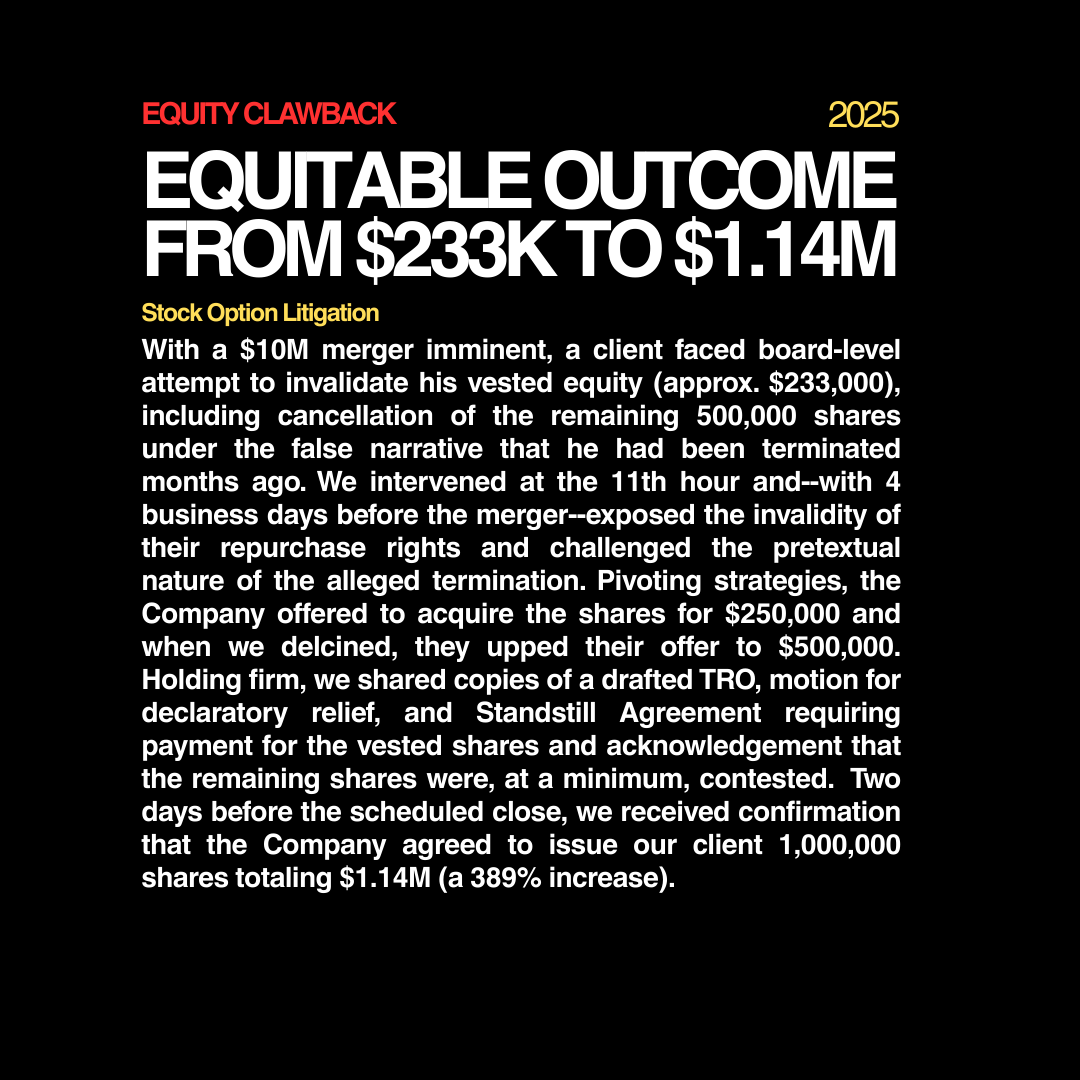
In the third quarter of 2025, we were engaged by an employee who was facing a potential wrongful termination and a CEO’s effort to repurchase vested equity estimated at around $233,000 — merely 72 hours prior to the scheduled completion of the company’s $10 million merger.
We swiftly intervened and analyzed the equity structure and corporate governance, prepared an emergency application for a Temporary Restraining Order, drafted a Motion for Declaratory Judgment, and devised a strategy for a Standstill Agreement aimed at imposing immediate pre-closing risks triggering disclosure requirements.
These documents were intentionally designed to solidify the decision-making process — each legal tool compelling a choice between unfavorable results. The Temporary Restraining Order posed a risk of completely blocking the merger (a scenario we intended to avoid). The Motion for Declaratory Judgment would shed light on the CEO’s actions publicly and necessitate recognition of our client’s rights, which could put the merger in jeopardy. The Standstill Agreement, which included a formal acknowledgment from the CEO concerning irregularities in the cap table, was crafted to enforce immediate disclosure obligations — forcing the CEO into a critical situation: reveal the dispute to the Board of Directors and acquiror, risking transaction instability and potential litigation, or rectify the equity issue quietly before the closing.
The CEO, through his attorneys, proposed $250,000 for the shares. We rejected the offer. When the offer was raised to $500,000, we turned it down once more and instead declared our intention to activate the Temporary Restraining Order, the Motion for Declaratory Judgment, and the Standstill Agreement.
In both life and legal matters, logic is rarely effective in isolation unless linked to self-preservation. To win, the repercussions of noncompliance must far outweigh the cost of compliance.
The following day, we received information that the CEO was conferring with the Board about granting the client 1,000,000 shares (valued at $1,140,000 million) — shares to which he had originally been entitled had it not been for the CEO’s overreach. The next day, the shares issued; the merger closed; and a new millionaire was minted.
Timeliness was vital to achieving our objective of securing an agreement before Sunday evening. By aligning with the timeline of the transaction, we were able to introduce risk at critical structural points that would significantly affect due diligence and representations and warranties, necessitating immediate prioritization and escalation to prevent the merger collapsing. For instance, the granting of additional shares required Board approval and, since our internal non-negotiable stipulation was either the issuance of actual shares or a documented acknowledgment of ownership, we needed to raise the issue to facilitate any Board meeting over the weekend, allowing for a buffer period for negotiations. We also had to consider that the CEO might try to circumvent pre-payment, disclosure, or Board approval which the Standstill Agreement was drafted to prevent.
Once the merger closed, leverage would have transitioned clearly in favor of the organization, with time taken for legal matters eating into any significant recovery. Before the closing, the risk scenario was reversed, yet with critical caveats: act prematurely and provoke the giant along with its team of large firm attorneys prepared to counter our strategies. But waiting too long poses the danger of forfeiting everything—no settlement compensation, no recorded ownership, and no rights to pursue post-merger, and against a newly formed entity with resources and time on their side. But now we’ll never know.