


Litigation Wins


From Dispute to Resolution: $233K into $1.14M—in 7 days.
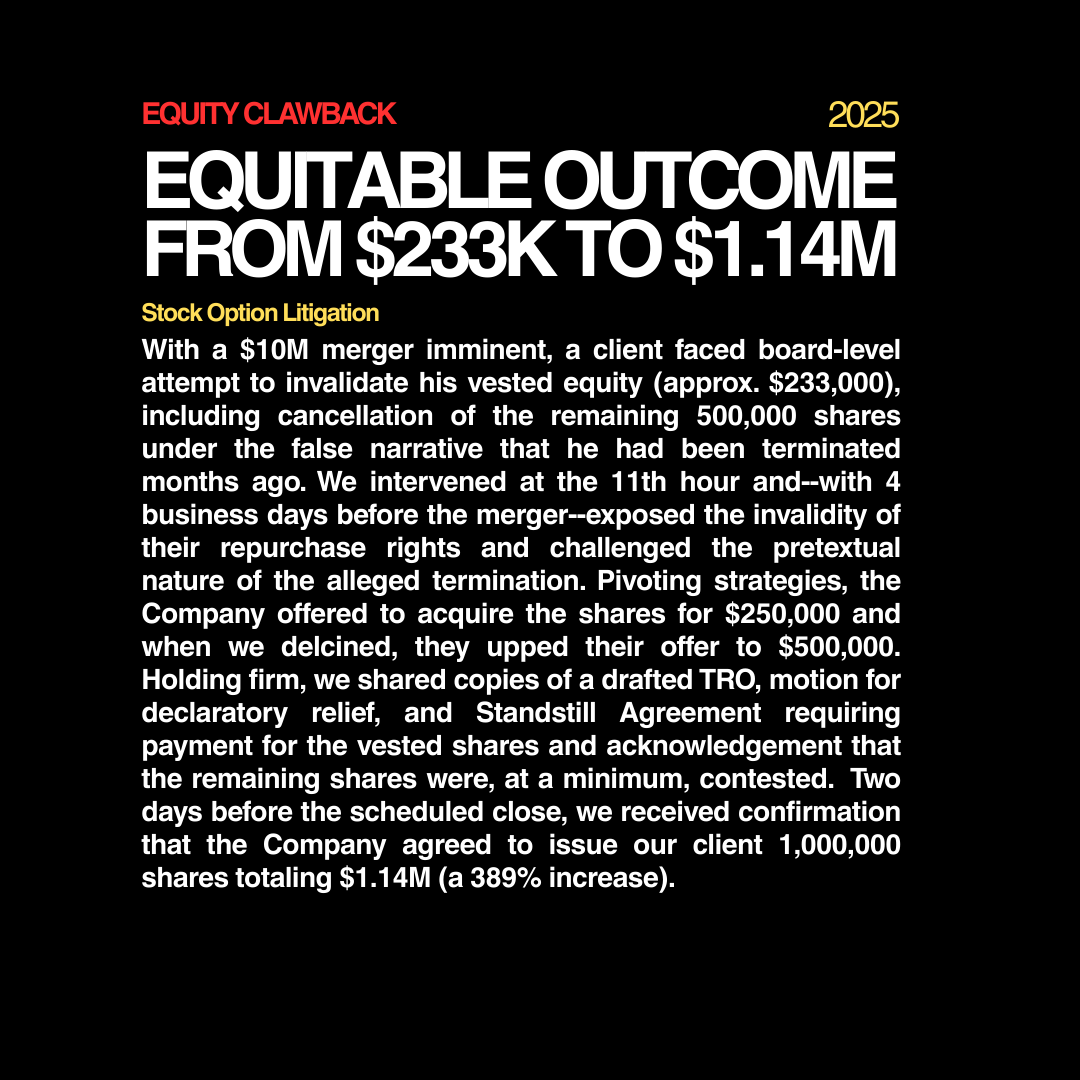
In the third quarter of 2025, we were engaged by an employee who was facing a potential wrongful termination and a CEO’s effort to repurchase vested equity estimated at around $233,000 — merely 72 hours prior to the scheduled completion of the company’s $10 million merger.
We swiftly intervened and analyzed the equity structure and corporate governance, prepared an emergency application for a Temporary Restraining Order, drafted a Motion for Declaratory Judgment, and devised a strategy for a Standstill Agreement aimed at imposing immediate pre-closing risks triggering disclosure requirements.
These documents were intentionally designed to solidify the decision-making process — each legal tool compelling a choice between unfavorable results. The Temporary Restraining Order posed a risk of completely blocking the merger (a scenario we intended to avoid). The Motion for Declaratory Judgment would shed light on the CEO’s actions publicly and necessitate recognition of our client’s rights, which could put the merger in jeopardy. The Standstill Agreement, which included a formal acknowledgment from the CEO concerning irregularities in the cap table, was crafted to enforce immediate disclosure obligations — forcing the CEO into a critical situation: reveal the dispute to the Board of Directors and acquiror, risking transaction instability and potential litigation, or rectify the equity issue quietly before the closing.
The CEO, through his attorneys, proposed $250,000 for the shares. We rejected the offer. When the offer was raised to $500,000, we turned it down once more and instead declared our intention to activate the Temporary Restraining Order, the Motion for Declaratory Judgment, and the Standstill Agreement.
In both life and legal matters, logic is rarely effective in isolation unless linked to self-preservation. To win, the repercussions of noncompliance must far outweigh the cost of compliance.
The following day, we received information that the CEO was conferring with the Board about granting the client 1,000,000 shares (valued at $1,140,000 million) — shares to which he had originally been entitled had it not been for the CEO’s overreach. The next day, the shares issued; the merger closed; and a new millionaire was minted.
Timeliness was vital to achieving our objective of securing an agreement before Sunday evening. By aligning with the timeline of the transaction, we were able to introduce risk at critical structural points that would significantly affect due diligence and representations and warranties, necessitating immediate prioritization and escalation to prevent the merger collapsing. For instance, the granting of additional shares required Board approval and, since our internal non-negotiable stipulation was either the issuance of actual shares or a documented acknowledgment of ownership, we needed to raise the issue to facilitate any Board meeting over the weekend, allowing for a buffer period for negotiations. We also had to consider that the CEO might try to circumvent pre-payment, disclosure, or Board approval which the Standstill Agreement was drafted to prevent.
Once the merger closed, leverage would have transitioned clearly in favor of the organization, with time taken for legal matters eating into any significant recovery. Before the closing, the risk scenario was reversed, yet with critical caveats: act prematurely and provoke the giant along with its team of large firm attorneys prepared to counter our strategies. But waiting too long poses the danger of forfeiting everything—no settlement compensation, no recorded ownership, and no rights to pursue post-merger, and against a newly formed entity with resources and time on their side. But now we’ll never know.
File If You Must
In the modern legal landscape, plaintiffs' firms often operate volume-litigation models. They scan hundreds of websites, invent a privacy violation, and send out mass demand letters threatening class-action lawsuits. Their goal isn't to go to trial; their goal is to extract a quick $10,000 to $15,000 "nuisance fee" from companies too afraid to fight back.
This is a case study on how we completely dismantled a California Invasion of Privacy Act (CIPA) shakedown, refused a $15,000 settlement demand, and forced the plaintiff's firm to abandon their own class action.
The Setup: The "Trap and Trace" Shakedown
A plaintiff's firm (Tauler Smith LLP) sent our tech client a demand letter alleging their website violated CIPA. The firm claimed that by using a "LinkedIn Insight Tag," our client was illegally deploying a "trap and trace" wiretap device to intercept user data. They demanded a settlement, threatening a class action seeking $5,000 per violation.
The Tactic: The Technical and Legal Audit
We don't pay extortion fees. We immediately ran a forensic audit of the client’s website and discovered a fatal factual flaw: the LinkedIn tracking pixel the plaintiff built their entire case around didn't even exist on our client's site.
But we didn't stop at the facts; we dismantled their legal theory. We weaponized recent, merits-stage court decisions (Sanchez v. Cars.com and Aviles v. LiveRamp) to prove that routine IP address routing is a basic function of the internet, not an illegal wiretap.
The Hammer: "File If You Must"
Realizing their leverage was evaporating, opposing counsel tried to pressure us, offering a "best and final" $15,000 settlement and threatening that the offer would be pulled the second they filed the lawsuit. We didn't blink.
We responded with a simple message:
"Thanks, Matt. Same answer. File if you must."
The Result: The Zero-Dollar Walkaway
The plaintiff's firm filed the complaint in state court, hoping the reality of a filed lawsuit would finally scare us into paying. It didn't. We completely ignored the filing.
Because we held the line, the plaintiff realized they were facing an unflinching adversary who would tear their case apart in court. They ultimately folded, allowing the strict 60-day service deadline to expire and effectively abandoning their own lawsuit. We secured a zero-dollar walkaway and neutralized a class-action threat without paying a dime.
Unwritten Does Not Mean Unenforceable
Employers often make grand promises about commissions and bonuses during the hiring process, but mysteriously "forget" to put them into a formal, signed contract. When it is time to pay up, they claim ignorance, hiding behind a simple defense: "We never put it in writing, so we don't owe you anything."
But in New York, a missing signature doesn't give an employer the right to steal your wages. This is a case study on how we took a high-level hospitality manager's "unwritten" $63,000 commission dispute and used raw internal data and New York Labor Law to force a massive payout.
The Setup: The Handshake Trap
Our client was a senior manager at one of Brooklyn's premier nightlife venues. Under an agreed-upon 1% commission structure, he generated massive revenue for the venue—over $3.5 million in table sales in a single year.
However, when it came time to separate, the venue refused to pay his earned $63,000 commission. Their defense was textbook: because there was no formally executed commission agreement, they had no legal obligation to pay him a dime.
The Lowball and the Stall Tactics
When employers think they hold all the cards, they stall. They ignore you, and then eventually toss out a lowball offer, acting as if they are doing you a massive favor.
Opposing counsel offered roughly 45% of what was owed, framing it as a generous concession:
"If you noticed we upped the settlement to 35k in good faith following our discussion with you... happy to get on a call Lawson, but quite frankly your client should take this. It took a lot of teeth pulling internally to get him this."
They wanted us to believe that their "internal friction" and lack of paperwork meant our client should walk away with pennies on the dollar. We didn't bite.
Finding Your Leverage: The Data Trail
You do not always need a formal contract if you have the receipts. Our client had brilliant foresight. Even without a signed agreement, he knew exactly how the company tracked its money. As he explained to us:
"Data is pulled from the Data Recking that has all revenue for each month. As noted in the SOP, that is where all data is pulled. That data is in the file I created with all table service revenue."
With the exact internal "Data Recking" reports and Standard Operating Procedures (SOPs) in hand, we could track his precise revenue generation down to the dollar. The venue could deny the contract, but they couldn't deny their own math.
The Checkmate Move: Statutory Liquidated Damages
We shifted the battlefield. We stopped arguing about a standard breach of contract and instead weaponized New York Labor Law. We sent opposing counsel a reality check:
"I understand [the Venue's] position is that there was nothing put into writing and therefore the venue believes there is no basis to pay the earned amount my client is seeking... That said, and I’m sure you probably already know, but earned commissions are wages even if the parties have not recorded the terms to paper so long as they are calculable and ascertainable."
Because we had the internal data, the commissions were strictly calculable. And under New York law, unpaid commissions are treated as stolen wages. We introduced the hammer—NY Labor Law §198—which provides for 100% liquidated damages for wage theft:
"NY Labor Law §198 provides for 'an additional amount as liquidated damages equal to one hundred percent of the total amount of the wages found to be due.' So the unpaid wages totaling $63,000 would quickly rocket up to hundreds of thousands if it is proven that the employer was willfully engaging in wage theft."
We then politely reminded them that this type of a wage theft liability was exactly the kind of thing the state aggressively prosecutes, especially given the venue’s less than popular credibility with the authorities:
"[T]his is the type of matter that NY Labor Department and NYS AG’s office would be interested in just given the wealth of confirmatory records gathered at this juncture."
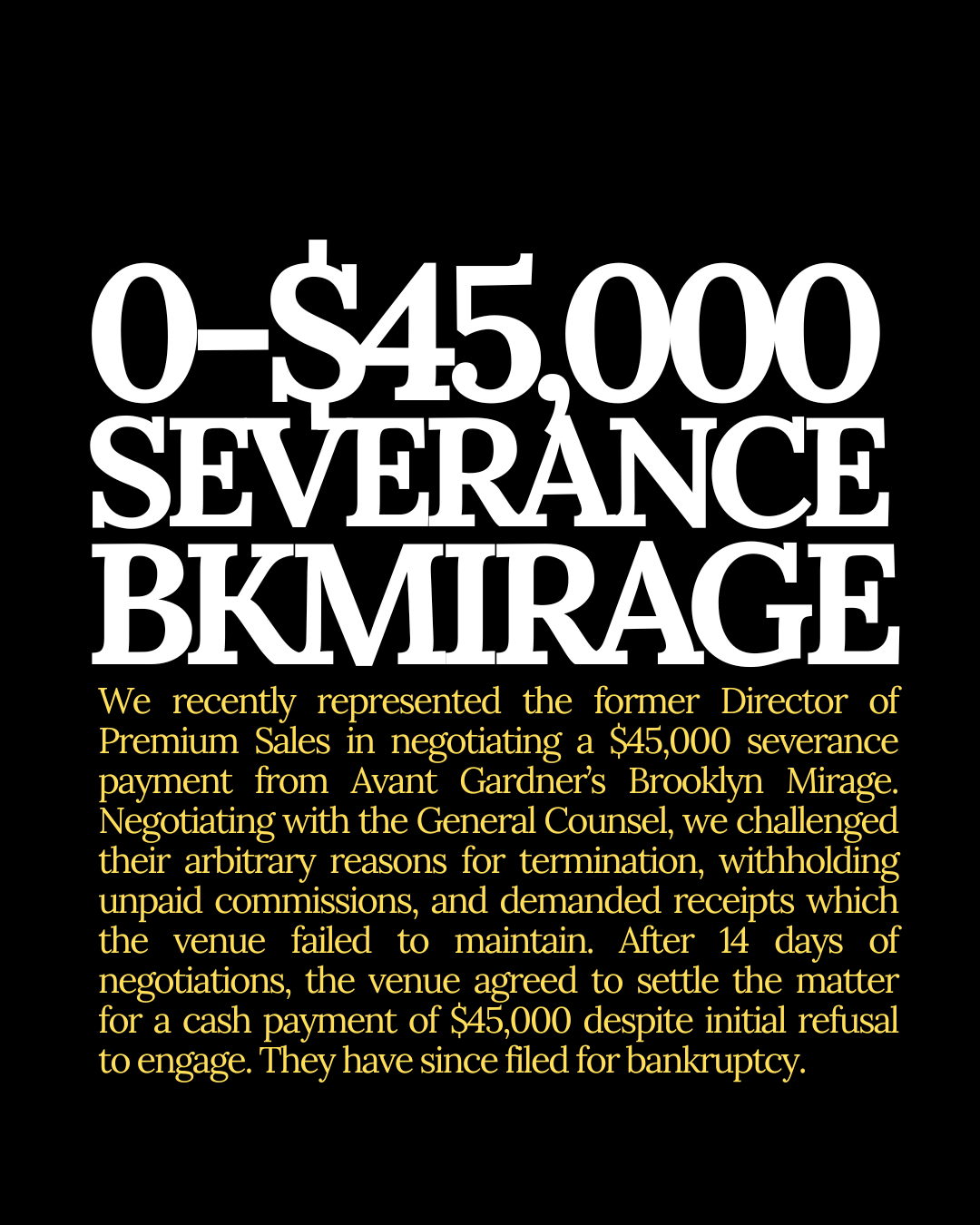
Faced with indisputable internal accounting data and the very real threat of a $200,000 public lawsuit and a potential Attorney General investigation, the venue's "no contract" defense completely collapsed. They dropped the bad-faith stalling and agreed to pay our client $45,000. From 0 severance to $45,000 in 12 days, we reminded the venue that while some employees might have capitulated, others wont.
The Takeaway
When an employer tries to use a missing signature to invalidate your hard work, do not accept their lowball offers. Gather the internal data, understand your statutory rights, and hit back. A missing contract is not a shield for wage theft, and with the right leverage, a fierce attorney, an unwritten promise can be a blank check.
The "Philanthropic Pivot"
When high-profile disputes arise with non-profit organizations or mission-driven entities, traditional litigation often presents a "lose-lose" scenario: the client faces significant legal spend and potential reputational damage, while the non-profit risks exhausting resources better spent on their cause.
In negotiating on behalf of a client facing a $50k demand for account credit or refund from a disgruntled non-profit, I have successfully pioneered a "Philanthropic Pivot" strategy, moving the conversation away from adversarial settlement demands and toward a sponsorship initiative. By reframing a legal liability as a corporate social responsibility (CSR) initiative, we resolved the underlying claim through a structured contribution to the organization’s flagship fundraising events.
The strategic value of this maneuver is multifaceted. It moves the remedy away from an account credit so that the company does not absorb the loss and the customer maintains freedom to contract elsewhere. It also effectively transforms a non-deductible legal settlement into a tax-deductible marketingand sponsorship expense, preserving the client's cash flow while satisfying the claimant’s financial needs. Lastly, it completely strips the "stigma" of a legal payout; instead of a public record of a dispute, the resolution generates positive PR and brand alignment with a respected cause. This creative approach not only settled the immediate conflict but 1) prevented litigation; 2) increased PR; 3) turned adversary to “partner”; and 4) transformed non-deductible legal expense into tax-deductible marketing expense. Instead of the dispute costing the client $50K, it instead became a tax-deduction.
How to Break a Debt-Dodging Tactic and Force a $50,000 Payout
In B2B disputes, unpaid invoices rarely start with an argument. They start with silence. A vendor provides a service, the client takes the value, and then suddenly, the client stops responding to emails.
When you finally send a legal demand, the silent debtor suddenly becomes very vocal. They hire counsel and invent a "breach" or "damages" out of thin air to justify why they shouldn't have to pay you.
This is a case study on how we took a tech client’s $67,000 outstanding invoice, dismantled the opposing party's fabricated "damages" defense, and forced a $50,000 lump-sum wire transfer by refusing to negotiate against ourselves.
The Setup: The Silent Debtor and the Kickstarter Smear
Our client, a global shipping technology platform (Easyship), managed the coordination and transport of inventory for a board game company (Druid City Games). After the delivery was completed, Druid City ignored the invoices.
Even when our client offered a $5,000 goodwill discount to resolve the balance amicably, Druid City remained silent. Instead of paying, they took to Kickstarter, pinning a defamatory comment blaming our client for their own delays.
We sent a formal demand letter giving them 7 days to pay the balance or face a lawsuit. Suddenly, their silence ended.
The Tactic: The Fabricated Dispute
Druid City hired outside counsel, and right on cue, the excuses poured in. Opposing counsel claimed that because some goods were shipped without adequate packing material, Druid City had suffered "reputational damage." They attempted to use this newly invented grievance to lowball us, offering a mere $35,000 to settle the $67,000 debt.
"Druid City’s position is that the parties agreed on certain requirements for the packing materials outside of the agreement... Druid City has suffered a significant impact to its reputation... discounting the offered $50,000 down to $35,000 takes into account only (approximately) twelve percent of the damages."
It was a classic smokescreen. They were trying to manufacture leverage where they had none.
The Reversal: The Contractual Shield
You do not entertain bad-faith math. We audited the contract and shut down their legal theory immediately. We pointed directly to the liability limitations in the agreement, proving that their grievance was entirely misplaced:
"Druid’s conduct has been telling—to delay, defer, and, ultimately dodge, payment it owes... Unfortunately, Druid's grievance is misdirected at the wrong party. The parties' agreement clearly outlines the expectations... See Section 9.1 ('Easyship will not be responsible for any damage or loss of goods. Any claims by Client will need to be made directly with the shipping carrier, partner, or insurer.')."
We made it clear: we were not going to discount an invoice based on a liability our client didn't legally hold.
The Hammer: The Exploding Offer
We countered at a firm $50,000. Opposing counsel tried to chip away at it. They asked if we would take $40,000. They asked if we would take $45,000. They claimed their client was acting on "emotion" and didn't have the liquidity for a lump sum.
We held the line. We gave them an exploding deadline: accept the $50,000 settlement, or we file the lawsuit on Monday morning and revoke the $5,000 goodwill discount entirely.
When opposing counsel tried to buy more time by using the Veterans Day holiday as an excuse to delay the deadline, we sent a message that made it clear the waiting game was over:
"While normally this would not be an issue, there's a pattern of excuses and delay that is unignorable. If nothing else, today’s holiday is a reminder of the honor in keeping commitments, even when inconvenient."
The Result: Complete Capitulation
Less than four minutes after we sent that final message, opposing counsel folded.
"Druid City has accepted $50,000 amount... Druid City is going to make a lump sum payment of the full amount."