
This article provides a practical framework for employers and employees navigating bonus-related disputes by discussing critical guidelines for evaluating whether work bonuses are considered “earned wages” under New York law and highlighting how the nature of bonus promises—such as the presence of a clear calculation formula, inducement to hire, guaranteed or eligible language, and method of communication—govern their legal standing.
Equally important to the calculus is the distinction between bonuses tied to individual performance and those based on company-wide profit, highlighting the importance of contractual terms and the satisfaction of performance targets in determining an employee’s right to payment.
-
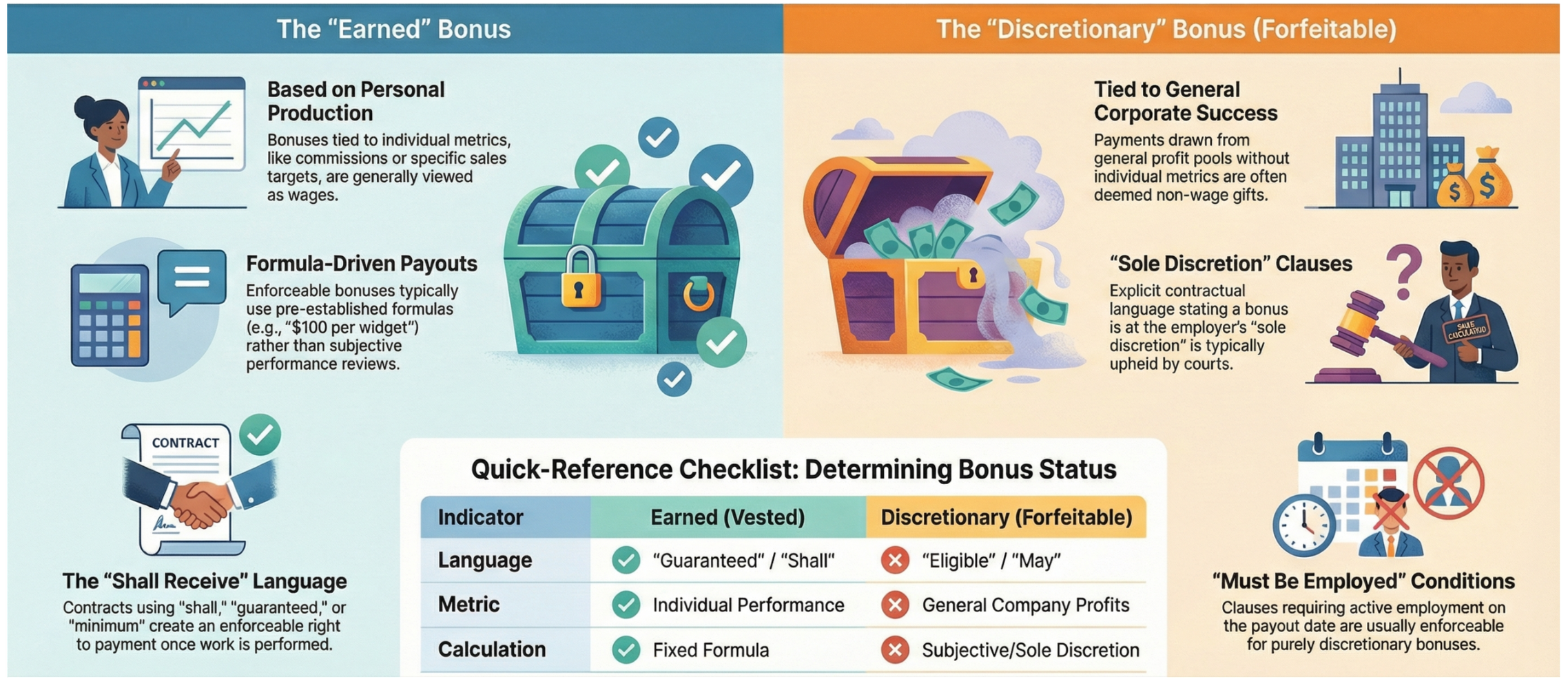
A bonus is likely enforceable if it is calculated using a pre-established formula (e.g., "$100 for every widget sold" or "10% of fees collected") rather than a subjective feeling about performance,.
-
Bonuses promised in an offer letter or as a specific inducement to join the firm are more likely to be viewed as "earned wages" once the employee starts work, rather than a gratuity,.
-
Language stating an employee is "eligible" for a bonus usually implies discretion, whereas terms like "guaranteed minimum" or "shall receive" suggest an enforceable right,.
-
While written contracts are preferred, an oral promise of a guaranteed bonus can be enforceable and vest as wages once the employee performs the work in reliance on that promise.
-
Bonuses linked to an employee's personal labor (e.g., commissions, placements made, specific sales targets) are generally treated as "earned wages" protected by labor laws.
-
onuses drawn from a general profit pool dependent on the employer's overall financial success (profit-sharing) are often deemed discretionary and not "wages," unless there is a specific implied contract to pay them.
-
If the bonus is tied to specific milestones (e.g., generating revenue above a threshold), and those milestones were met, the bonus is likely earned. Once the criteria are satisfied, the employer often loses the discretion to withhold payment.
-
If the contract unambiguously states the bonus is at the employer's "sole discretion" and creates no fixed obligation, courts typically enforce that discretion,,.
-
Even if labeled "discretionary," a bonus may be deemed "earned" if the employer’s course of dealing (consistent past payments) or the specific bonus structure (targets/formulas) creates a reasonable expectation of payment.
-
Courts may find that "discretion" applies only to the amount of the bonus, not the obligation to pay something if performance goals were met.
-
If an employer has consistently paid a bonus in prior years based on specific targets, this "course of dealing" can create an implied contract or "reasonable expectation" that the bonus is part of earned compensation,,.
-
Check if the contract says it is the "entire agreement." This might block evidence of oral promises, though specific wage laws sometimes override this.





Sample Itinerary-
Workshop participants ease into the day with creative prompts and a welcome circle to get grounded and set the tone.
-
Our first session focuses on the foundations of floral design. From tool basics to flower care and simple composition tips, you’ll start building confidence and finding your creative rhythm.
-
Participants will be responsible for brining their own lunch, but we'll provide water and some additional snacks throughout the day.
-
With the basics fresh, we’ll dive into hands-on arranging. We’ll explore shape, scale, and movement while encouraging personal style through floral design.
-
To close the day, you’ll create a final piece to share with the group. We’ll reflect on your process and celebrate the creativity that unfolded.

meet your instructors
Monet Goode
Monet is a lifelong educator with a passion for creating accessible, engaging learning experiences. Known for a calm, encouraging teaching style, Monet believes that growth happens when learners feel both challenged and supported.

Emmett Marsh
Emmett is a detail-oriented instructor who’s spent the past decade helping people develop new tools, habits, and mindsets. Their approach is clear, practical, and always infused with curiosity and care.

Eleanor Parks
Eleanor's background spans education, coaching, and creative development. With a strong focus on process and progress, Eleanor helps learners move from where they are to where they want to be—one step at a time.
Still have questions? Take a look at the FAQ or reach out anytime. If you’re feeling ready, go ahead and register for a workshop.
Your Questions, Answered-
Getting started is simple. Reach out through our contact form or schedule a call—we’ll walk you through the next steps and answer any questions along the way.
-
How can I contact you?
-
You can reach us anytime via our contact page or email. We aim to respond quickly—usually within one business day.
-
We offer flexible pricing based on project type and complexity. After an initial conversation, we’ll provide a transparent quote with no hidden costs.